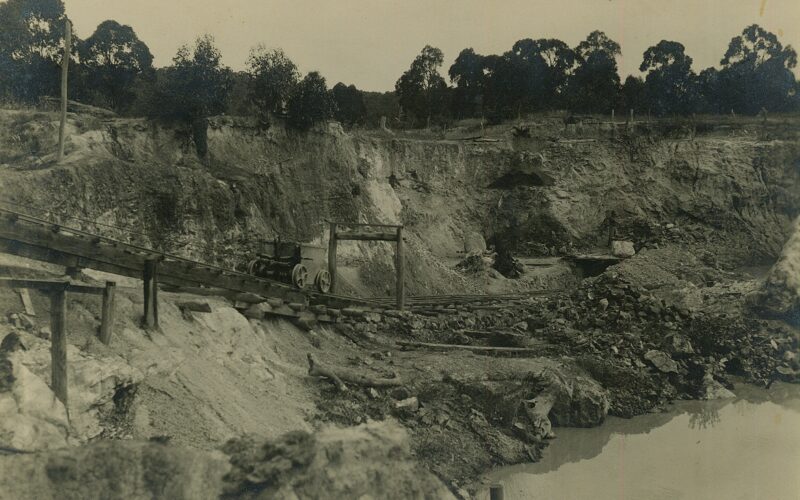
The original brickworks in Glen Innes were started by John Falconer Willis and W Newman in about 1872 at Bell Rock, on what was formerly known as the Common, where they quarried with shovels, and pugged and moulded the bricks by hand.
‘Commons’ on the outskirts of towns were originally set aside in the 19th and 20th centuries so that people who lived in a town had somewhere to graze their stock -mostly milking cows, and horses for transport.
It is great news that the New England Heritage Traction Club Inc has been appointed Crown Land Managers of the Heritage listed later Brickworks established about the turn of the century when John Willis and his son Arthur Bickham moved the business to Thomas Street.
Clays have been quarried from behind the Thomas street factory, an ironstone clay quarry on Strathbogie road and cream clay from dumps of overburden belonging to tin mines at Emmaville.
Blue was considered the highest quality of all bricks produced in Glen Innes and they varied from grey blue to deep blue black.
Some of the largest local buildings built of Glen Innes bricks include portions of the old hospital, now museum, Convent – 220,000 bricks, District Services Club, Bowling Club, Presbyterian Manse and Hall, and, 1956 Glen Innes Hospital – 1,330,000 bricks.
In a heritage study the brickworks were described as…‘a rare example of early industrial enterprise reflecting not only technological innovation, but also the social and economic history of regional NSW… holding an exceptional significance as the only surviving intact steam-powered brickworks in Australia, making it a site of national technical, industrial, and social heritage importance. It stands as a rare example of early industrial enterprise, reflecting not only technological innovation but also the social and economic history of regional New South Wales’…
The Traction Club’s initial focus on ‘repairing and replacing damaged roofing and guttering is both practical and vital. Without this work, further deterioration could endanger the survival of this irreplaceable site’.
The Open Day on Sunday June 14 will be a great opportunity to see brickmaking machinery, steam engine and kilns with guided tours and a 1985 film of it all working etc., and much more!
Thomas street was named after Follet Johns Thomas (1863 -1942) – Chemist & partner in Thomas & Howard (site of Amcal). He was an Alderman, Mayor, & MLA.