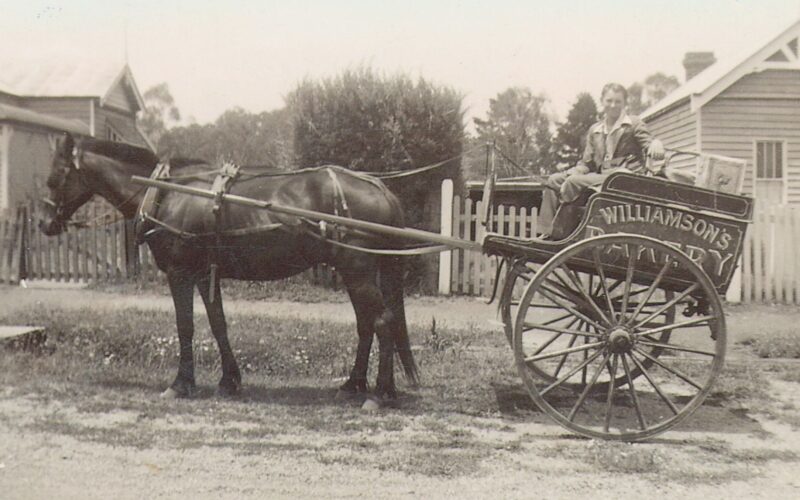
Matthew and Catherine Williamson bought the IXL Bakery from Frank Willis the day World War 1 was declared and sold it the day the end of hostilities was announced.
As well as the usual locals, Williamsons had a huge clientele to supply – the army camp at the Golf links, the Agricultural Experimental Farm and the Prison Farm.
Catherine remembered the drawn-out process: “Bread was made by hand by placing large bags of flour, yeast and other ingredients in wooden troughs and when mixed, left to rise for several hours. Then it was kneaded on top of the trough, and cut and rolled into different shapes and sizes, then moulded and left to rise again, then put into individual tins and left to rise again before being placed in the oven.
The fire was lit about an hour before the bread was ready – the wood was bought in cord loads, about 3 feet long. The large brick oven was about 18-20 feet long, with a furnace at the side, about six feet.
Testing of the oven was done by scattering a handful of flour across the oven, depending on your own judgement as to how long the flour took to catch alight.
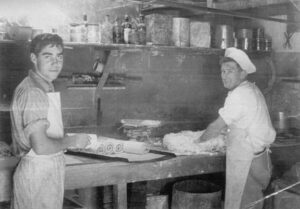
An average oven held 350 loaves and approximately 5,000 were made each week. One bag of flour made 100 loaves, each loaf weighing 2 pounds 4 ounces before cooking – allowing 4 ounces moisture loss.
There were only two varieties brown and white producing High Top, Married Tin, Sandwich and Vienna.
Bread was delivered all round town by horse and cart six days a week, and by mail vans to outside areas at no extra cost. The cost of bread then was 4 ½ pence a loaf, pies 3 pence and a bun loaf 3 pence.
Pies were supplied to cafes at 2 shillings and six pence a dozen.”
Bob Irish who originally worked for Charlie Smith at 303 Grey street remembered other bakers in the town then – James Henville, Charlie Hunt, C A Pearson, Les Hill, and Charlie Leet.
Smeatons bought out C A Pearson in 1942 and later also Smiths, Henvilles, & Leets.
Carl Baer ran the bakery at Deepwater, and Jack Curnow at Emmaville (his ad mentioned he did mail order!) Bread was also commercially baked in the villages of Red Range and Ben Lomond.